|
Free Unix!
Starting this Thanksgiving I am going to write a complete Unix-compatible software system called GNU (for Gnu’s Not Unix), and give it away free (1) to everyone who can use it. Contributions of time, money, programs and equipment are greatly needed… – Richard Stallman; Posting to net.unix-wizards; 27 Sept. 1983. |
|
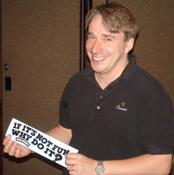
Hello everybody out there using minix – I’m doing a (free) operating system (just a hobby, won’t be big and professional like gnu) for 386(486) AT clones… I’d like to know what features most people would want. Any suggestions are welcome, but I won’t promise I’ll implement them 🙂 – Linus Torvalds; Posting to comp.os.minix; 25 Aug. 1991. |
Who invented Linux? Linux is the first truly free Unix-like operating system. The underlying GNU Project was launched in 1983 by Richard Stallman originally to develop a Unix-compatible operating system called GNU, intended to be entirely free software. Many programs and utilities were contributed by developers around the world, and by 1991 most of the components of the system were ready. Still missing was the kernel.
Linus Torvalds invented Linux itself. In 1991, Torvalds was a student at the University of Helsinki in Finland where he had been using Minix, a non-free Unix-like system, and began writing his own kernel. He started by developing device drivers and hard-drive access, and by September had a basic design that he called Version 0.01. This kernel, which is called Linux, was afterwards combined with the GNU system to produce a complete free operating system.
On October 5th, 1991, Torvalds sent a posting to the comp.os.minix newsgroup announcing the release of Version 0.02, a basic version that still needed Minix to operate, but which attracted considerable interest nevertheless. The kernel was then rapidly improved by Torvalds and a growing number of volunteers communicating over the Internet, and by December 19th a functional, stand-alone Unix-like Linux system was released as Version 0.11.
On January 5, 1992, Linux Version 0.12 was released, an improved, stable kernel. The next release was called Version 0.95, to reflect the fact that it was becoming a full-featured system. After that Linux became an underground phenomenon, with a growing group of distributed programmers that continue to debug, develop, and enhance the source code baseline to this day.
Torvalds released Version 0.11 under a freeware license of his own devising, but then released Version 0.12 under the well established GNU General Public License. More and more free software was created for Linux over the next several years.
Linux continued to be improved through the 1990’s, and started to be used in large-scale applications like web hosting, networking, and database serving, proving ready for production use. Version 2.2, a major update to the Linux kernel, was officially released in January 1999. By the year 2000, most computer companies supported Linux in one way or another, recognizing a common standard that could finally reunify the fractured world of the Unix Wars. The next major release was V2.4 in January 2001, providing (among other improvements) compatibility with the upcoming generations of Intel’s 64-bit Itanium computer processors.
Although Torvalds continued to function as the Linux kernel release manager, he avoided work at any of the many companies involved with Linux in order to avoid showing favoritism to any particular organization, and instead went to work for a company called Transmeta and helped develop mobile computing solutions, and made his home at the Open Source Development Labs (OSDL), which merged into The Linux Foundation.
(1) This remark shows that Richard had not yet clarified the distinction between “free speech” and “free beer”. [Comment added by Richard. Stallman]
Resources. The following sites provide more information on Linux: