|
Since Leibniz there has perhaps been no man who has had a full command of all the intellectual activity of his day. Since that time, science has been increasingly the task of specialists, in fields which show a tendency to grow progressively narrower. A century ago there may have been no Leibniz, but there was a Gauss, a Faraday, and a Darwin. Today there are few scholars who can call themselves mathematicians or physicists or biologists without restriction. A man may be a topologist or an acoustician or a coleopterist. He will be filled with the jargon of his field, and will know all its literature and all its ramifications, but, more frequently than not, he will regard the next subject as something belonging to his colleague three doors down the corridor, and will consider any interest in it on his own part as an unwarrantable breach of privacy. – Wiener, Norbert; Cybernetics; 1948. |
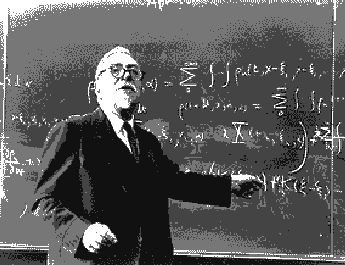
Norbert Wiener invented the field of cybernetics, inspiring a generation of scientists to think of computer technology as a means to extend human capabilities.
Norbert Wiener was born on November 26, 1894, and received his Ph.D. in Mathematics from Harvard University at the age of 18 for a thesis on mathematical logic. He subsequently studied under Bertrand Russell in Cambridge, England, and David Hilbert in Göttingen, Germany. After working as a journalist, university teacher, engineer, and writer, Wiener he was hired by MIT in 1919, coincidentally the same year as Vannevar Bush. In 1933, Wiener won the Bôcher Prize for his brilliant work on Tauberian theorems and generalized harmonic analysis.
During World War II, Wiener worked on guided missile technology, and studied how sophisticated electronics used the feedback principle — as when a missile changes its flight in response to its current position and direction. He noticed that the feedback principle is also a key feature of life forms from the simplest plants to the most complex animals, which change their actions in response to their environment. Wiener developed this concept into the field of cybernetics, concerning the combination of man and electronics, which he first published in 1948 in the book Cybernetics.
Wiener’s vision of cybernetics had a powerful influence on later generations of scientists, and inspired research into the potential to extend human capabilities with interfaces to sophisticated electronics, such as the user interface studies conducted by the SAGE program. Wiener changed the way everyone thought about computer technology, influencing several later developers of the Internet, most notably J.C.R. Licklider.
In 1964, Norbert Wiener won the US National Medal of Science. In the same year, he published one of his last books called “God and Golem, Inc.: A Comment on Certain Points Where Cybernetics Impinges on Religion”.
Resources. The following sites related to Norbert Wiener and cybernetics have been established for several years.
- Principia Cybernetica has more than a thousand pages, including a list of influential Cybernetics and Systems Thinkers.
- The Research Committee on Sociocybernetics is a member of the International Sociological Association, and operates under the auspices of UNESCO to “promote the development of (socio)cybernetic theory and research within the social sciences”.
- The American Society for Cybernetics, whose objective is to “develop a metadisciplinary language with which we may better understand and modify our world.”
- The Bacterial Cybernetics Group collected evidence of cybernetic sophistication by bacteria, including advanced computation, learning, and creativity.
Lists of sites: