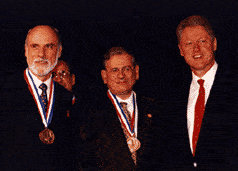
– Vinton Cerf, Robert Kahn, U.S. President Bill Clinton
|
This document describes the Interplanetary Internet: a communication system to provide Internet-like services across interplanetary distances in support of deep space exploration. The communications environment is characterized by high bandwidth-delay products resulting from very long signal propagation delays, intermittent connectivity that results in long periods of network partitioning, and discontinuities in the capabilities of adjacent networks. – Vinton Cerf, et. al.; Interplanetary Internet; May 2001. |
Vinton (Vint) Cerf, along with Robert Kahn, is co-designer of the TCP/IP Internet network protocol.
In 1972, Vinton Cerf was a DARPA scientist at Stanford University in California when he was appointed chairman of the newly created International Network Working Group (INWG), inspired by the earlier Network Working Group, and with a charter to establish common technical standards to enable any computer to connect to the ARPANET. Later, Cerf worked with Alex Curran from Bell Northern Research to “place INWG into the International Federation of Information Processing (IFIP) galaxy of technical committees”, and eventually it became known as IFIP Working Group 6.1, a subgroup of Technical Committee 6 which focused on communications systems.
Cerf worked on several interesting networking projects at DARPA, including the Packet Radio Net (PRNET), and the Packet Satellite Network (SATNET). In the spring of 1973, he joined Robert Kahn as Principal Investigator on a project to design the next generation networking protocol for the ARPANET. Kahn had experience with the Interface Message Processor, and Cerf had experience with the Network Control Protocol, making them the perfect team to create what became TCP/IP.
Cerf and Kahn started by drafting a paper describing their network design, titled “A Protocol for Packet Network Interconnection”, which they distributed at a special meeting of the INWG at Sussex University in September, 1973, and then finalized and published in the IEEE Transactions of Communications Technology, in May, 1974.
Cerf and Stanford graduate students Yogen Dalal and Carl Sunshine published the first technical specification of TCP/IP as an Internet Experiment Note (IEN) as RFC 675, in December, 1974. Their design included a 32 bit IP address, with eight bits for identification of a network, and 24 bits for identification of a computer, which provided support for up to 256 networks, each with up to 16,777,216 unique network addresses.
It was assumed that the network design would eventually be re-engineered for a production system, but the architecture proved remarkably robust. Cerf has said that once the network was developed and deployed, it just “continued to spread without stopping!”
Cerf has continued to perform research and contribute to the development of the Internet through work with the communications company MCI and the Internet management organization ICANN. Among other awards and honours, he shared the Charles Stark Draper Prize for 2001 with Kahn, Leonard Kleinrock, and Larry Roberts for their work on the ARPANET and Internet.
Resources. Vinton Cerf is the author of three entertaining RFC’s, and contributed to a fourth:
- RFC 968; Twas the Night Before Start-up; December, 1985
- RFC 1121; Leonard Kleinrock, Vinton Cerf, Barry Boehm; Act One — The Poems; September, 1989; Presented at the Act One symposium held on the 20th anniversary of the ARPANET
- RFC 1217; Memo from the Consortium for Slow Commotion Research (CSCR); April 1st, 1991; in response to RFC 1216
- RFC 1607; A View From The 21st Century; April 1st, 1994
Other online publications by Vinton Cerf are listed below: